Current Issue
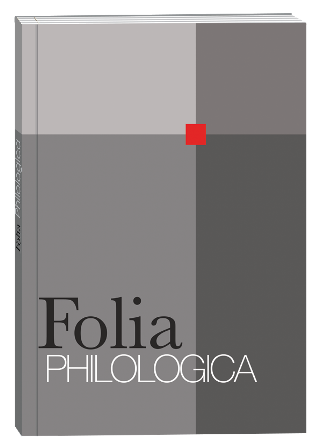
Folia Philologica. Kyiv: Taras Shevchenko National University of Kyiv, 2026. № 11. 116 p.
Founder: Taras Shevchenko National University of Kyiv
Recommended for printing: 13.08.2026
Full Issue
Статті
 Title of the journal: Folia Philologica.
Founder: Taras Shevchenko National University of Kyiv.
Year of foundation: 2020.
ISSN: 2786-5908 (Print), 2786-5916 (Online).
Registration of Print media entity: Decision of the National Council of Television and Radio Broadcasting of Ukraine: Decision No. 1450 as of 25.04.2024.
Media ID: R30-04491.
Media entity: Taras Shevchenko National University of Kyiv (60, Volodymyrska Str., Kyiv, 01033, e-mail: office@knu.ua, tel. +380 44 239-33-33).
The journal is included in the List of Scientific Professional Publications of Ukraine in accordance with Order No. 928 of the Ministry of Education and Science of Ukraine dated June 11, 2026 (Appendix 15). The journal has been assigned Category “B” for three years, from June 1, 2026, to May 31, 2029.
Cluster: Humanities and Arts.
Specialty: B11 - Philology (with specializations).
Cluster: Humanities and Arts.
DOI: https://doi.org/10.17721/folia.philologica
Periodicity: 2 times a year.
Publication languages: Ukrainian, English, German, Polish, Lithuanian.
Publisher: Taras Shevchenko National University of Kyiv (EDRPOU code 02070944, 60, Volodymyrska Str., Kyiv, 01033, e-mail: office@knu.ua, tel. +380 44 239-33-33). Publisher's ROR: https://ror.org/02aaqv166.
The editorial board accepts individual articles submitted by postgraduate students enrolled in state-funded programs for publication free of charge, provided that the manuscripts are authored solely by the students (without co-authors), comply with the journal’s requirements, and adhere to the principles of academic integrity.
The journal is included in the international scientometric database Index Copernicus International (Republic of Poland).
All journal issues are archived in the V. I. Vernadsky National Library of Ukraine.
The goal of Folia Philologica is to publish recent research findings on topical issues of modern linguistics and literature studies, which contribute to the dynamics of theory and/or methodology of the relevant subject area.
The scientific journal draws attention to dominant factors in the development of modern philology, highlighting the challenges of linguistics (linguophilosophy, applied, corpus and computational linguistics, cognitive linguistics, comparative linguistics, communication linguistics, discourse study, psycholinguistics, ecolinguistics, linguopalaeontology, political linguistics, etc.) and literature studies (comparative studies, receptive aesthetics, literature and media, intermedia research, poetics, the history of literature).